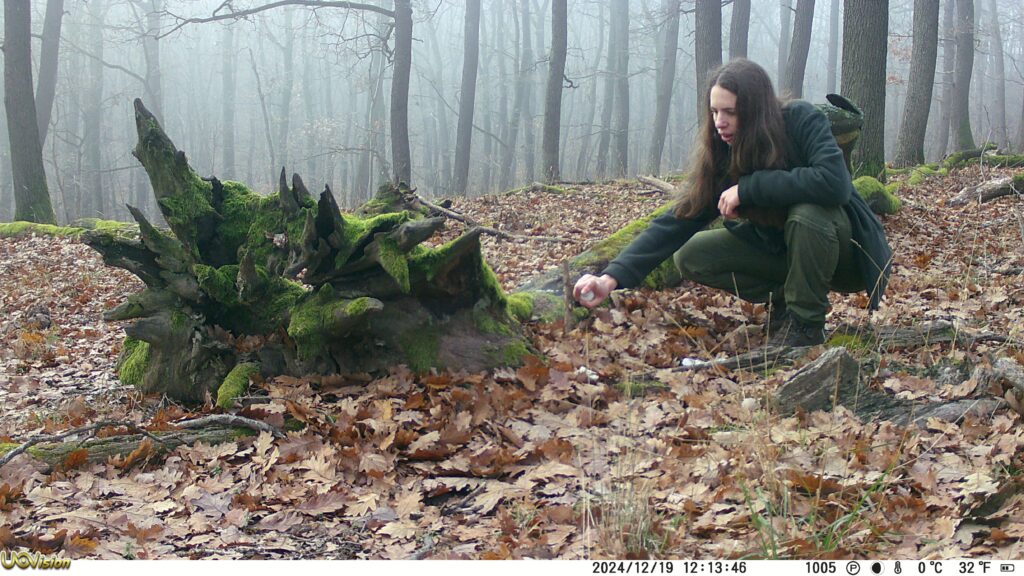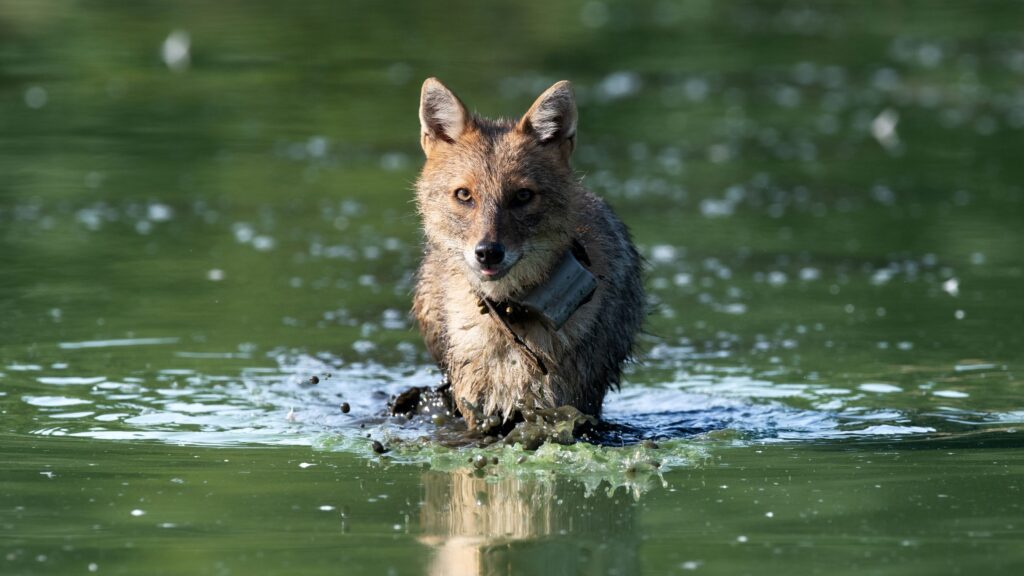

Lilla Burányi Virág, a Master's student in Wildlife Engineering at the Hungarian University of Agricultural and Life Sciences, conducted a questionnaire and field survey to better understand the population of the wildcat, a predator species that is difficult to study due to its hidden lifestyle and small numbers, and the least studied in Central Europe. Flower's research has been supported by our Foundation through a successful grant application, and the camera trap survey in the Visegrad Mountains will be extended to include nine wildlife cameras in autumn 2023. We congratulate the student and her supervisor, Dr. Zsolt Biró, on the results of their research and wish them good luck for the future!
Camera-trapping and questionnaire survey of wild cat(Felis silvestris) in the Pilis-Buda mountains
Author: by Lilla Burányi Virág, supervisor: Dr. Zsolt Biró
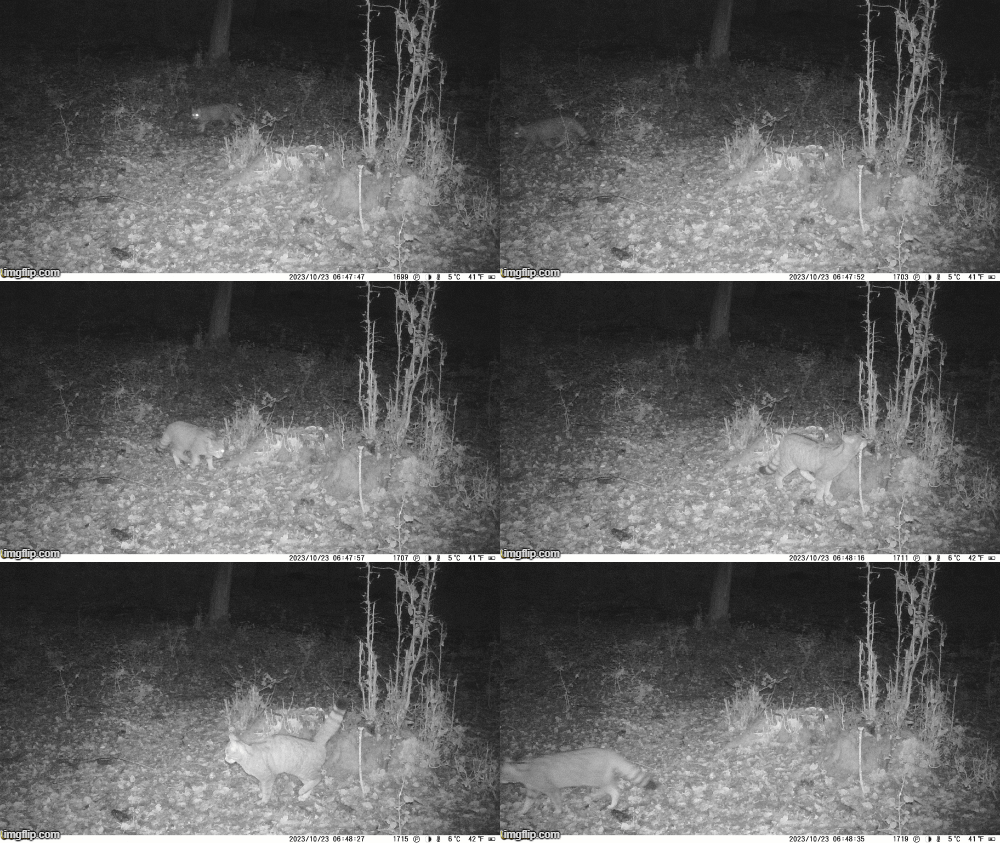
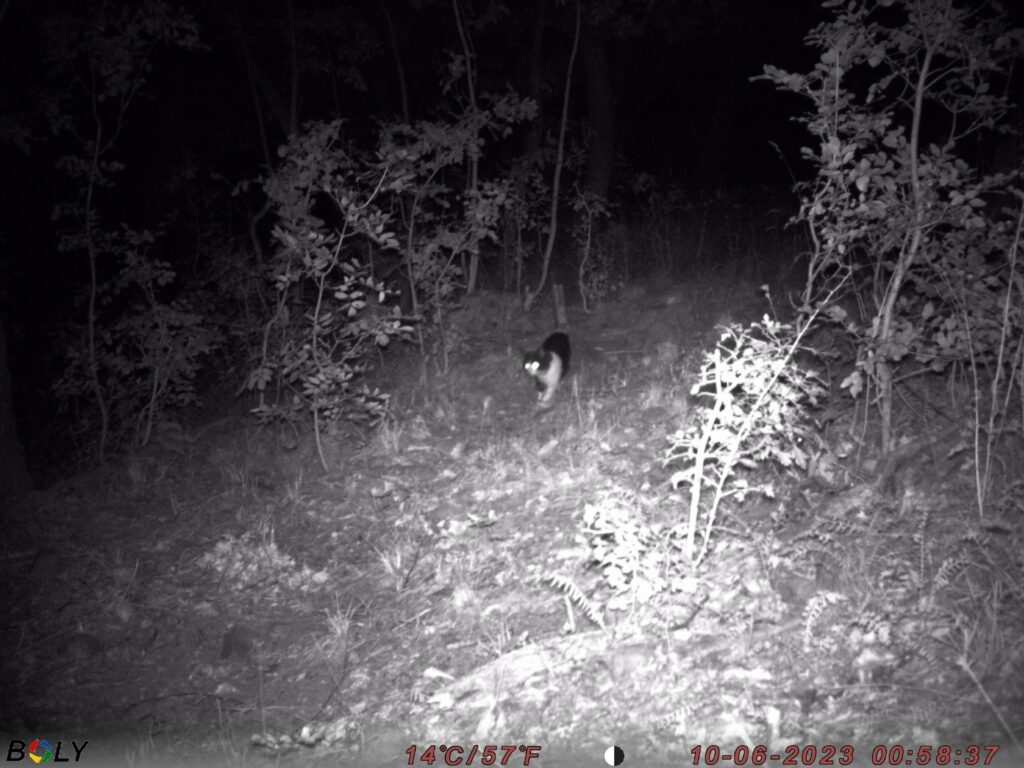
The feral cat(Felis silvestris) (see Figure 1) is protected worldwide, but there are countries - such as Hungary - where numbers are alarmingly low and in constant decline. The main reasons for the decline are anthropological: habitat fragmentation and degradation, illegal hunting, road kill, declining populations of prey animals, competition with domestic cats(Felis catus) (see Figure 2), and the risk of potentially communicable diseases and hybridisation with them. The mixing of the two species(Felis silvestris x Felis catus) will result in the genetic stock of the feral cat being so degraded that, when mixed with all the other threat components, it could be on the verge of extinction in the wild in Hungary. Due to its hidden lifestyle, avoidance of humans and small numbers, the wildcat is a difficult to study and least studied predator in Central Europe. Unfortunately, there is still insufficient information on the exact size, distribution and land use of the feral cat population in our country.
In my thesis I wanted to find solutions to these problems. My objectives were.
1. Do wild cats live near the capital, in the area of Pilisi Parkerdő Zrt.?
My first hypothesis is that the individuals (feral cats, domestic cats and their hybrids) seen in camera trap photos can be identified by coat pattern, species level and individual level.
2. Does the population living in the area of Pilis Parkerdő Zrt. recognise the wild cat and know what factors are the most threatening to the species?
My second hypothesis is that respondents with a professional qualification are more successful at recognising wildcats than those without a professional qualification.
My third hypothesis is that respondents with a professional education rank the factors that threaten feral cats more highly than respondents without a professional education.
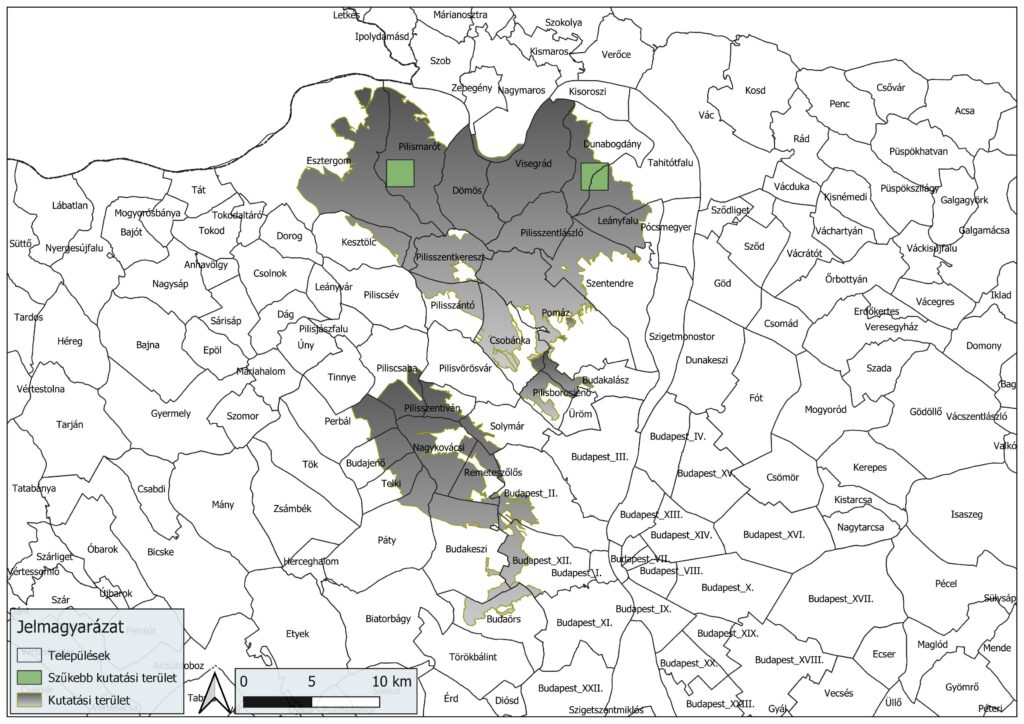
My field research was carried out in the Visegrad Mountains, where I conducted gridded camera trap surveys in two areas (Tahitótfalun and Pilismaróton) from October 2023 to March 2024 (see Figure 3). My research was supported by the Fauna and Flora Foundation with 9 wildlife cameras, so I was able to observe felid behaviour in Tahitótfalu and Pilismaró without disturbance. In addition, I was able to carry out camera trap checks with the support of the Foundation.
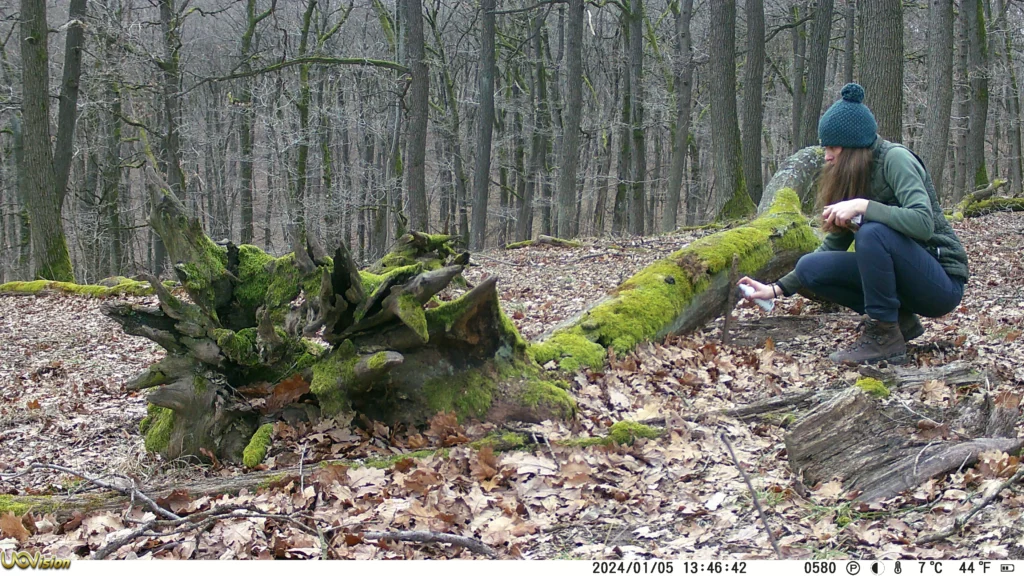
My aim was to use the camera traps to get a picture of the occurrence of feral and domestic cats and their hybrids. In addition to the feral cameras, I used various attractants (catnip, catnip root) and decoys (oily fish), which have been used successfully in the literature, placed next to the hair collection stake. I checked the camera traps on a monthly (sometimes bi-monthly) basis, updated the attractant and bait materials (see Figure 4), replaced missing hair collectors, and replaced memory cards and batteries in the cameras when necessary. For each camera, I kept a log of any cat sightings, which I updated and recorded. I sorted through all the photos taken with the wildlife cameras (ignoring those that did not contain the animal) and sorted the target species - feral cat, domestic cat, their hybrid - into separate folders. For the cat photos, I tried to identify the individuals individually by coat pattern where possible.
The centre of the wildlife cameras in Tahitótfalu was the DINPI/1 camera at Nádasto meadow, where in previous years a camera trap photo of a wildcat had been taken.DINPI/1 is located 2.7 km west of the nearest edge of the settlement. A quadrat system of 8 camera points was assigned to this central camera, where it was planned to place the cameras 1 km apart, with the aim of covering 400 ha of forest area. Unfortunately, only 7 cameras were available, so in the end the cameras were deployed at the locations indicated by the red dots and the serial numbers of the cameras (BKVP/2, BKVP/3, etc.) as shown in Figure 5.
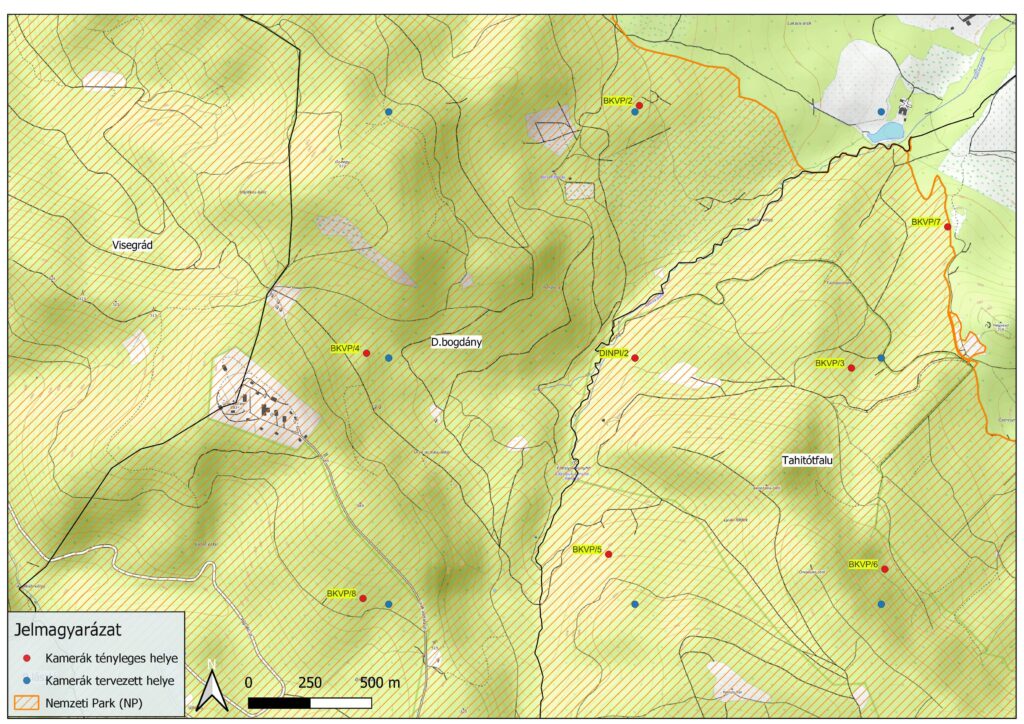
(Source: DINPI/Novák, 2024)
In Pilismaró, I followed a similar principle, with the starting centre of the quadrat system (BKVP/13) being the site of the release of the future wild cat - Saffi - (near the Hamvaska Hunting Lodge), with the nearest edge of the settlement 3.2 km to the south-west. The additional cameras (BKVP/9, BKVP/10 etc.) were marked 1 km apart from the central camera, with blue dots indicating the planned location and red dots and camera numbers (BKVP/9, BKVP/10 etc.) indicating the actual location of the cameras (see Figure 6).
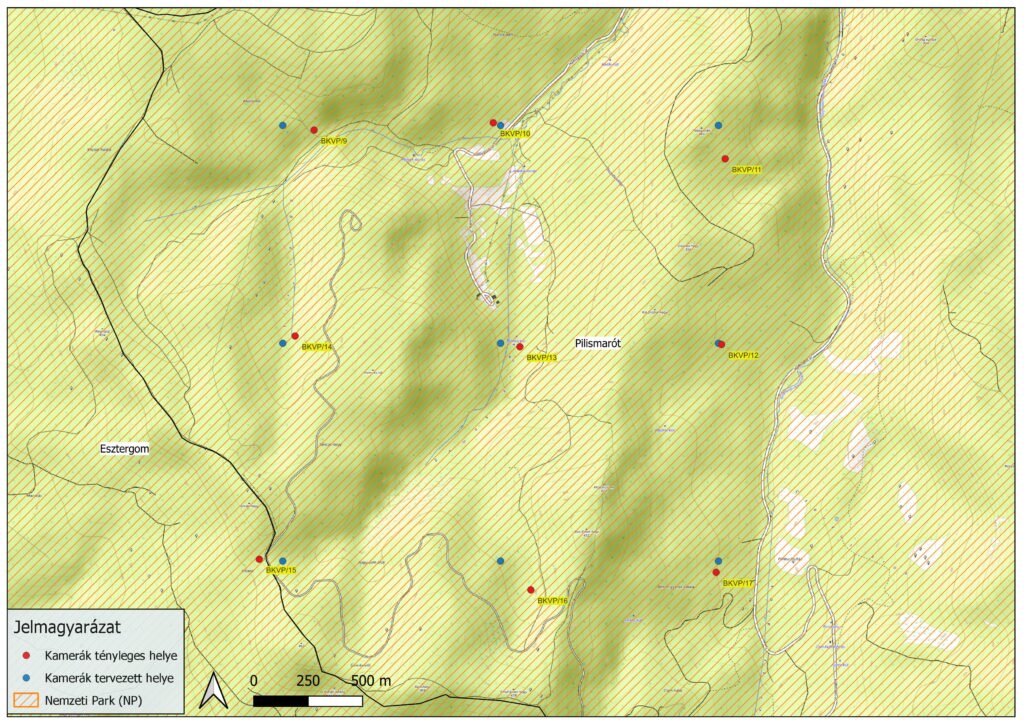
(Source: DINPI/Novák, 2024)
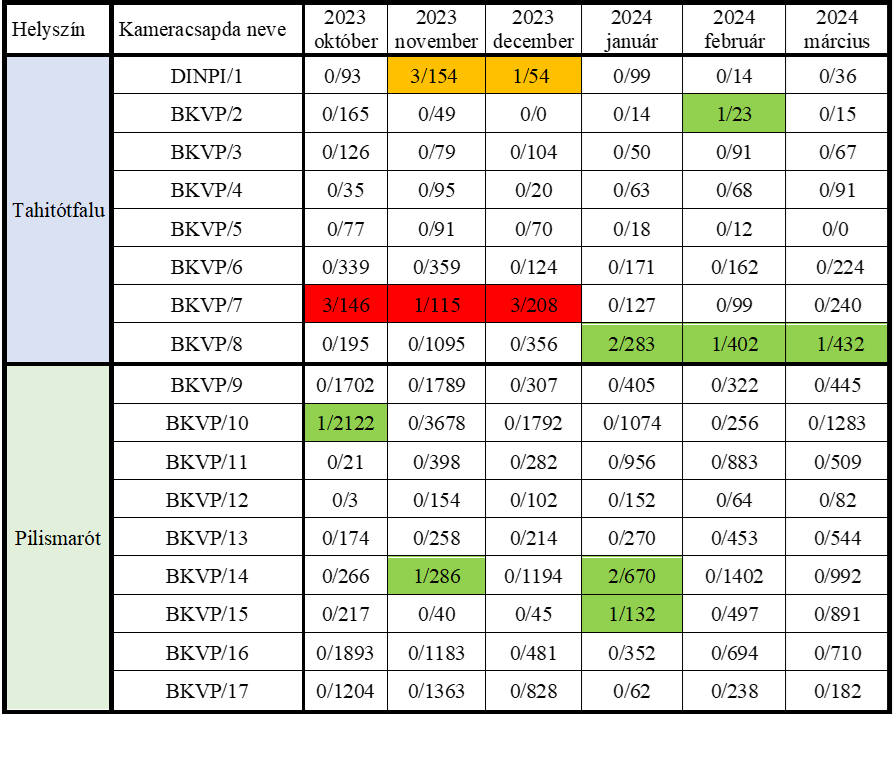
Between October 2023 and March 2024, I spent a total of 13 field days inspecting the camera traps and hair collection stakes in Tahitian village. In half a year, a total of 6927 animal photos were taken using 8 wildlife cameras, 4 hybrid cat, 5 feral cat and 7 domestic cat sightings.
Between October 2023 and March 2024, I spent a total of 14 field days inspecting the camera traps and hair collection stakes at Pilismaróti. During half a year, a total of 36516 animal photos were taken with 9 wildlife cameras and 5 wildcat sightings were made.
Table 1 shows a summary of the results for the last six months at the two sites, with red highlighting the distinctly domestic cat occurrence, green the feral cat occurrence and orange the presumed hybrid occurrence. I counted as a single sighting photos taken within 10 minutes, and as multiple sightings if more than 10 minutes elapsed between two cat photos. Unfortunately, in many cases I found that very blurry images of the animals were captured, so I could not always determine whether the same feral cat was seen over and over again in the images or whether several different feral cats were captured.
Based on my camera trap investigation, it has been proven that there are feral cats living near the capital, in the area of the Pilis Park Forest Ltd. However, my first hypothesis - that the individuals (feral cats, domestic cats and their hybrids) seen in the camera trap photos can be identified by fur pattern, species level and individual level - did not prove feasible in all cases. I think that in the future it would be worth using only cat hairs from the attractive ones and omitting the bait bite, so that perhaps hairs can be collected more successfully from cats and then subjected to genetic analysis for speciation.
In March 2023, I started indirectly sampling an online public questionnaire using a Google form, which I disseminated through various media platforms to find out people's knowledge about feral cats and the threats to the species. I finally closed the questionnaire in March 2024, so I accepted responses for a whole year, and finally 1157 people completed my questionnaire, which I filtered down to the residents who live in the Pilis Parkerdő Zrt. area, giving me a total of 308 people. 23% (71 people) had a professional qualification (forester, forest engineer, wildlife or conservation engineer, biologist, veterinarian, etc.), while 77% (237 people) did not.
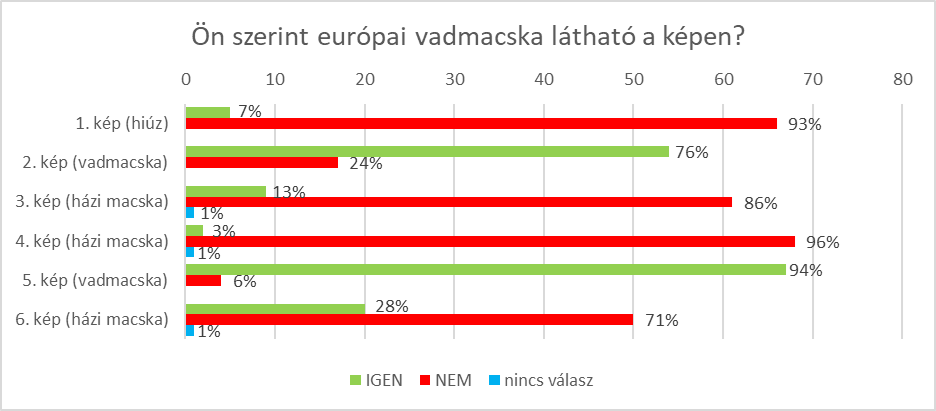
Next, I looked at how successfully the 71 people who had a professional qualification could recognise a feral cat and distinguish it from a domestic cat or a lynx (see Figure 7).
I then similarly looked at the success rate of the 237 people who had no professional qualifications in recognising wildcats (see Figure 8).
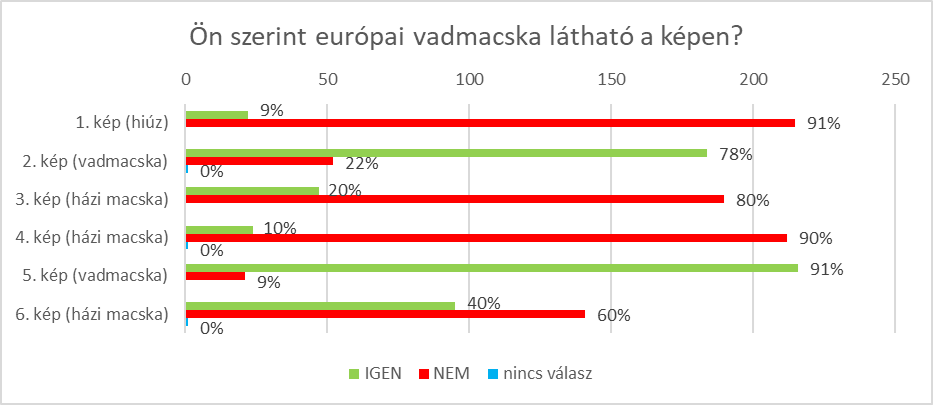
For image 1, the chi-square test shows that there is no relationship between the respondent's professional qualification and the correctness of the answers (X2 (1, N = 308) = 0.3429, p = 0.558). Lay people confused the lynx with the wildcat at the same rate as those with a professional qualification. image 2, the chi-square test showed that there was no relationship between the respondent's professional education and the recognition of the wildcat (X 2 (1, N = 307) = 0.1142, p = 0.735), i.e. the same proportion of those with professional education (76% correct) and those without (78% correct) recognised the wildcat. For Figure 3, the chi-square test showed no relationship between the respondent's professional education and the correctness of the answers (X 2 (1, N = 307) = 1.762, p = 0.184). Lay people were as likely to confuse the domestic cat with the wild cat as those with a professional education. For Figure 4, the chi-square test showed a trend level relationship between the respondent's professional education and the correctness of the answers (X 2 (1, N = 306) = 3.712, p = 0.054). A higher proportion of non-professionally educated laypersons mistook the domestic cat in the picture for the wild cat than those with a professional education. For picture 5, the chi-square test showed no relationship between the respondent's professional education and the recognition of the wild cat (X 2 (1, N = 308) = 0.7628, p = 0.382), i.e. the same proportion of respondents with (94% correct answers) and without (94% correct answers) professional qualifications recognised the wildcat. For Figure 6, the chi-square test showed no relationship between the respondent's professional education and the correctness of the answers (X 2 (1, N = 307) = 0.132, p = 0.716). Lay people were as likely to confuse the domestic cat with the wild cat as those with a professional education.
Based on the chi-squared tests performed, and only in the case of picture 4 was there a trend-level relationship between the respondents' professional qualifications and the correctness of their answers, my second hypothesis was not confirmed, i.e. that those with professional qualifications would perform better in identifying feral and domestic cats. In my opinion, this may be a reflection of the self-reporting system of the questionnaire (who considers themselves an expert) and suggests that active environmental education and training is still important to increase public awareness and recognition of feral cats. I think it is a great initiative to have the feral cat as the mammal of the year 2024, but more emphasis needs to be placed on online and offline educational materials to raise awareness of the domestic cat and feral cat.
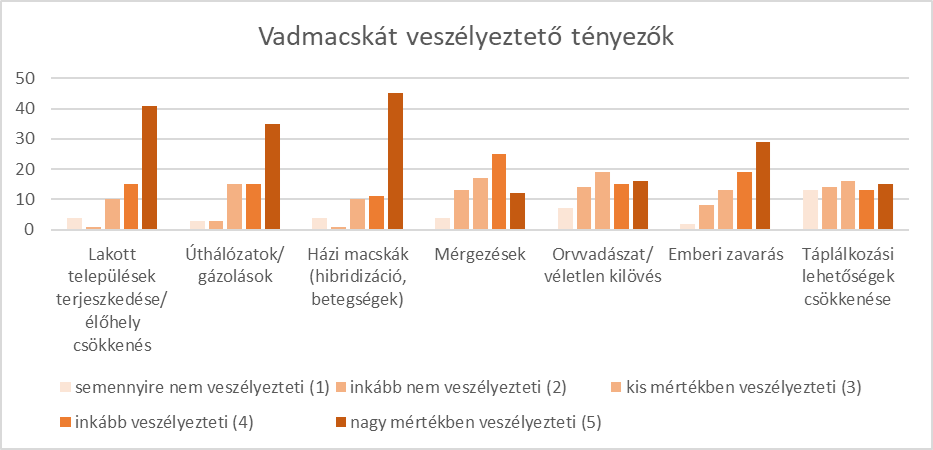
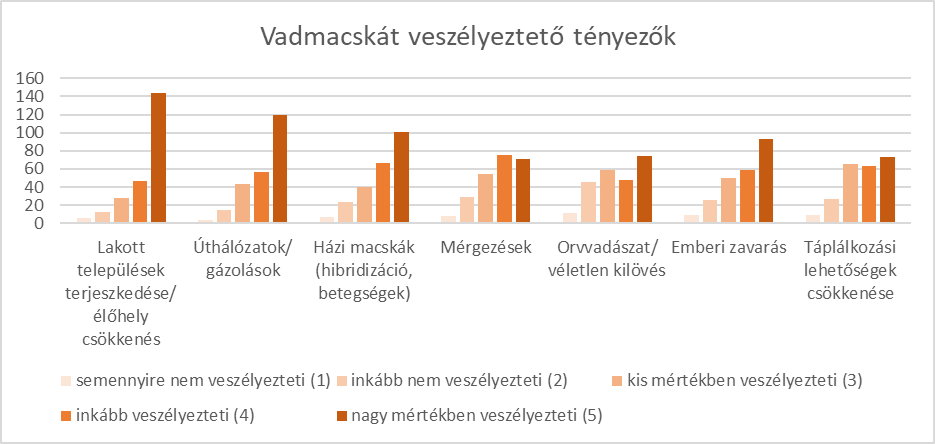
In analysing the population questionnaire, I used Spearman's rank correlation to determine whether there was a difference between how professionally educated respondents (see Figure 9) and nonprofessionally educated respondents (see Figure 10) judged the importance of factors that threaten wild cats.
(Source: own work, 2024)
The Spearman correlation showed a strong, significant, positive relationship between the two rankings (rs(N308)) = 0.857, p=0.014). ) Thus, my third hypothesis was not fulfilled, as respondents with a professional education ranked the factors that threaten wild cats similarly to those without a professional education. Ultimately, this is positive, as a large part of the population is aware of the threats to feral cats (hybridisation with domestic cats, mortality due to fumigation, habitat loss). I suggest that we then start to put into practice what we already know, i.e. to keep our domestic cats responsibly, to create more feral cat crossings and to actively protect the natural habitats of feral cats.
Cover photo by Linda Surányi